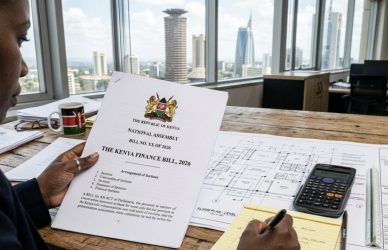


Pressure is mounting on Kenya’s government to reform the country’s Pay As You Earn (PAYE) tax system as accountants, bankers, and financial experts warn that rising payroll deductions are squeezing household incomes, weakening consumer spending, and discouraging formal employment.
The debate gained momentum during stakeholder hearings before Parliament’s Finance and National Planning Committee, where the Institute of Certified Public Accountants of Kenya (ICPAK), the Kenya Bankers Association (KBA), and audit firm Deloitte jointly called for sweeping PAYE reforms. Their proposals include widening tax bands, increasing the tax-free income threshold from KSh24,000 to KSh30,000, and reducing the highest PAYE rate to ease pressure on salaried workers.
The growing push for reform comes at a time when many Kenyans are already grappling with increased statutory deductions under the Social Health Insurance Fund (SHIF), higher National Social Security Fund (NSSF) contributions, and the Affordable Housing Levy. Together, these deductions have significantly reduced take-home pay for thousands of employees across the country.
Why Experts Believe Kenya’s PAYE System Needs Reform
According to ICPAK, Kenya’s current payroll tax structure has become overly aggressive, particularly for middle-income earners. Under the existing system, workers earning just above KSh32,333 per month already fall into the 30% PAYE tax bracket — a threshold many experts argue is too low compared to regional peers.
The accountants’ body noted that Kenya’s tax bands are narrower and steeper than those in countries like Ghana, where higher tax rates apply only at significantly larger income levels. This, they argue, suppresses disposable income, reduces household savings, weakens investment capacity, and places disproportionate pressure on formal sector workers.
ICPAK proposed a revised PAYE structure with:
- 10% tax band
- 15% tax band
- 20% tax band
- 25% tax band
- 28% top rate
The institute also recommended increasing personal tax relief and broadening lower-income thresholds to protect workers struggling with the rising cost of living.
Meanwhile, Deloitte urged lawmakers to align the top PAYE rate with Kenya’s corporate tax rate by capping it at 30%, arguing that excessive payroll taxation discourages productivity, talent retention, and economic growth.
Banks Warn of Economic Consequences
The Kenya Bankers Association framed the issue as more than just a tax matter, warning that shrinking disposable incomes are beginning to affect the broader economy.
According to KBA estimates, lowering PAYE rates and widening lower tax bands could inject more than KSh28 billion annually into household incomes. That additional spending power could:
- Boost consumer demand
- Stimulate business activity
- Improve loan repayment capacity
- Support job creation
- Strengthen private sector growth
Banks are increasingly concerned that excessive payroll deductions are weakening borrowers’ ability to service loans, potentially increasing default risks and slowing credit growth across the economy.
Government Faces a Difficult Balancing Act
Despite growing support for PAYE reforms, the Treasury faces mounting fiscal pressure that limits its room for tax relief measures.
Committee Chairperson Kuria Kimani revealed that Treasury simulations estimate that raising the tax-free threshold to KSh30,000 could create a revenue shortfall of approximately KSh35 billion annually.
This presents a major dilemma for the government, which is already struggling with:
- A national debt exceeding KSh13 trillion
- Rising debt servicing obligations
- Budget deficits
- Pressure to maintain stable tax revenues
Currently, debt servicing reportedly consumes nearly two-thirds of Kenya’s ordinary revenue, making PAYE one of the government’s most reliable and predictable sources of income.
The Treasury had earlier signaled plans to exempt workers earning below KSh30,000 from PAYE through a separate Tax Laws (Amendment) Bill, but the proposal was later shelved due to revenue concerns. Officials also linked the delay to lower fuel VAT collections after the government reduced taxes on petroleum products.
What This Means for Kenyan Businesses and Employees
The PAYE reform debate highlights a growing challenge facing Kenya’s economy: balancing government revenue needs with the financial wellbeing of workers and businesses.
For employers, rising employee financial pressure can lead to:
- Lower productivity
- Increased staff turnover
- Reduced consumer spending power
- Weaker business demand
For employees, continued increases in payroll deductions may further strain household budgets amid inflation, housing costs, healthcare contributions, and economic uncertainty.
As businesses navigate these changing economic realities, professional financial planning, payroll optimization, and tax advisory services are becoming increasingly important.
At Janta Kenya, businesses and professionals can access expert support in:
- Payroll management
- Tax planning and compliance
- Financial advisory
- Business restructuring
- HR and workforce solutions
- Corporate financial strategy
In today’s evolving tax environment, proactive financial planning is essential for protecting both business sustainability and employee wellbeing.